
New Product Released
I built a thing that tells you if the kitchen has flies in it
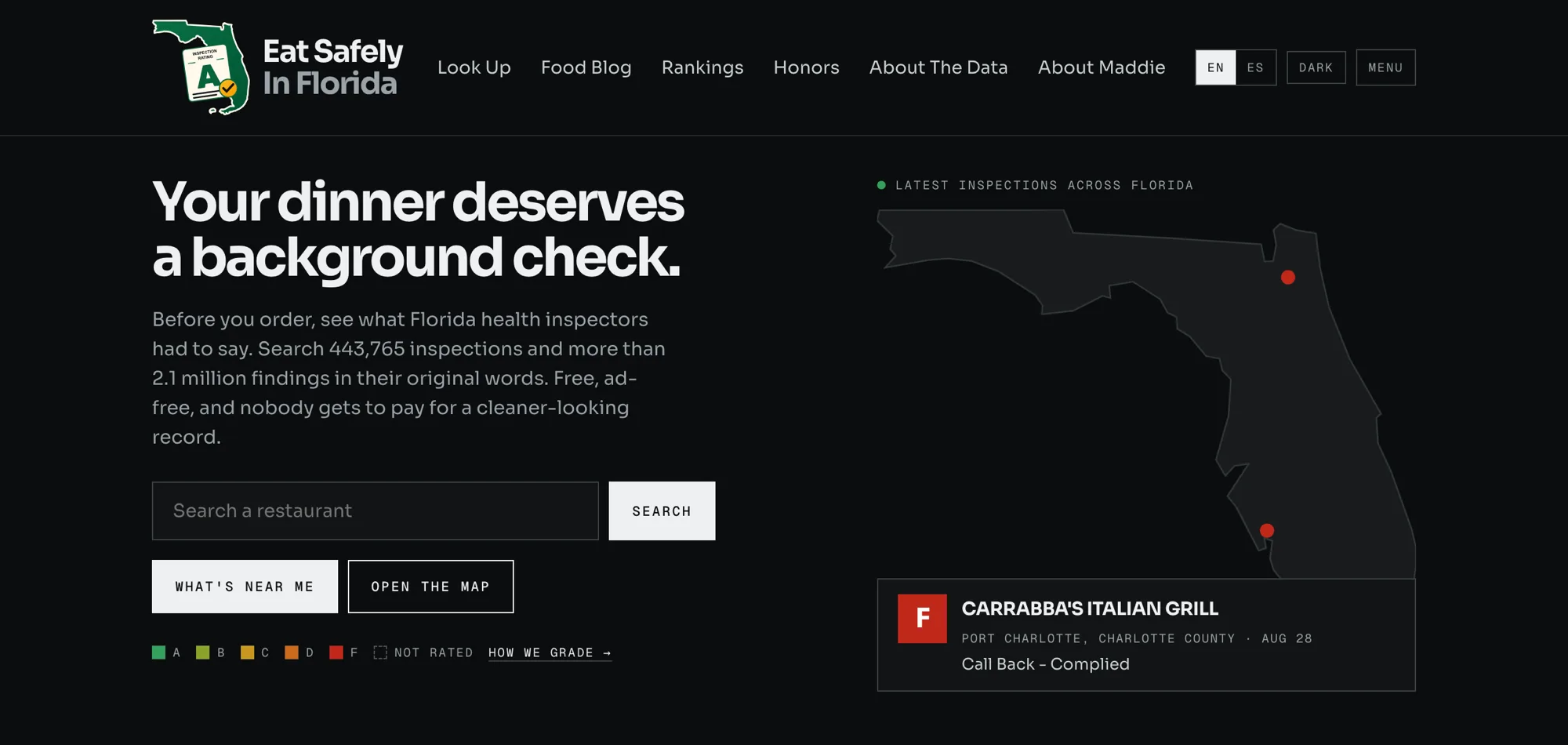
Florida inspects restaurants. It writes down what it finds. And then, technically, it publishes all of it — which is not the same thing as letting you read it.
The data is genuinely public. It's a public record under Chapter 119, it comes out as spreadsheets on a state website, and you are welcome to go and get them. Whether you can do anything with a folder of CSVs while standing outside a restaurant at 7pm, deciding whether to walk in, is a different question.
So I built Eat Safely In Florida. It's out now. It's free, there are no ads, and there is no version of it where a restaurant pays me to look better.
What It Actually Does
Every inspection the state has on file — 443,765 of them, and more than 2.1 million individual findings — in a form you can search. Type a restaurant name. Get the record.
The findings are the inspector's own words. Not summarized, not tidied up, not spell-checked. If an inspector wrote “Live, small flying insects found 2 live flies in prep area”, that is what you see, comma splice and all. I decided early that the moment I start rewriting these so they read nicely, I have started editing evidence, and I am not doing that. Choosing which finding to show you first is mine. The words never are.
Every place gets a grade, A through F, from a formula that is written out on the site so you can check my working. The grade is not a vibe.
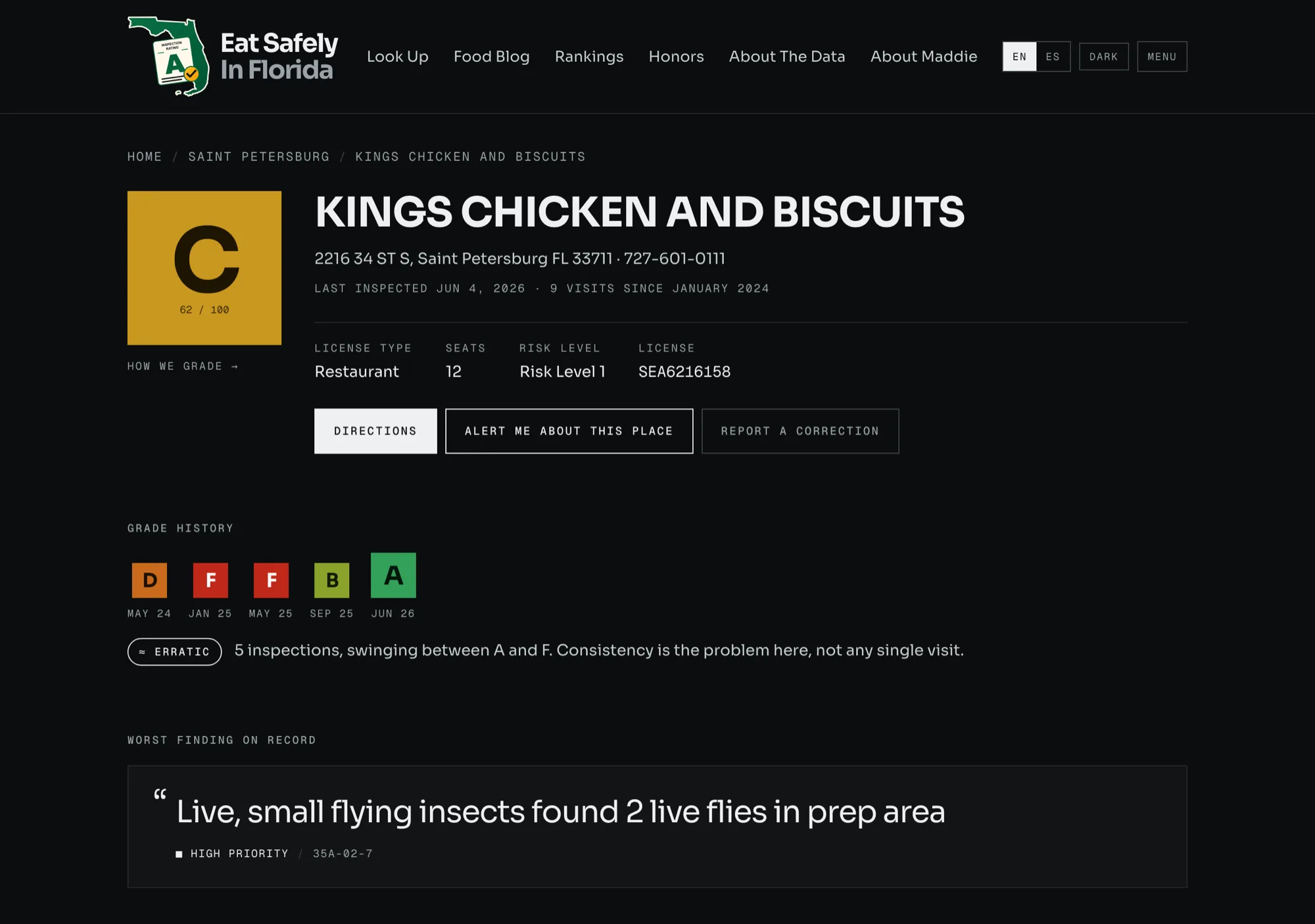
That history is the bit I am proudest of. A C on its own tells you very little. A C sitting on top of D, F, F, B, A tells you something a single score never can, and the site says it out loud: five inspections, swinging between A and F. Consistency is the problem here, not any single visit.
A kitchen that had one bad Tuesday is not the same as a kitchen that cannot hold a standard. One number can't tell those apart. Five, in order, can.
The Part I Care About Most
Almost everything in this space is a wall-of-shame machine. Bad news gets clicked, so bad news is what gets built.
I didn't want that. There is a Hall of Fame as well as a Hall of Shame, a most-improved list, and badges for kitchens that pass again and again. If a small place has come through thirteen straight inspections clean, that is genuinely difficult and absolutely nobody was telling them well done. Now something does.
And the other half of it: you cannot pay to come off the site. There is no reputation-management tier, no takedown fee, no premium listing that quietly floats you up the page. If your record is bad, the way to fix it is a better inspection. That is the entire product.
How It's Built, For The Two Of You Who Care
One Cloudflare Worker, one SQLite database, HTML rendered on the server. Nothing is scraped — the state publishes the extracts and I read them properly, which is both more polite and considerably more reliable. A job runs every night, pulls whatever is new, and recomputes the grades.
It's dark by default. Color on that site only ever means a grade, which is why it has no brand color at all: if something is green, it scored well, full stop. Severity is a shape and a word rather than a hue, so the page still works if red and green aren't doing for you what the designer assumed they would.
What Isn't Done
Spanish. The routes are stubbed and the page is already emitting hreflang tags, which at the moment makes me a liar — that's the next job. Printable certificates for the kitchens that have earned one. Share cards. It started as one county and now covers the state, which happened faster than I planned and left a few seams showing.
It'll get there. It's out, which is the hard part.
Go Look Someone Up
Try the place you were going to eat at tonight. That is genuinely the whole point of it — not to scare you off restaurants, but to let you walk into one already knowing.